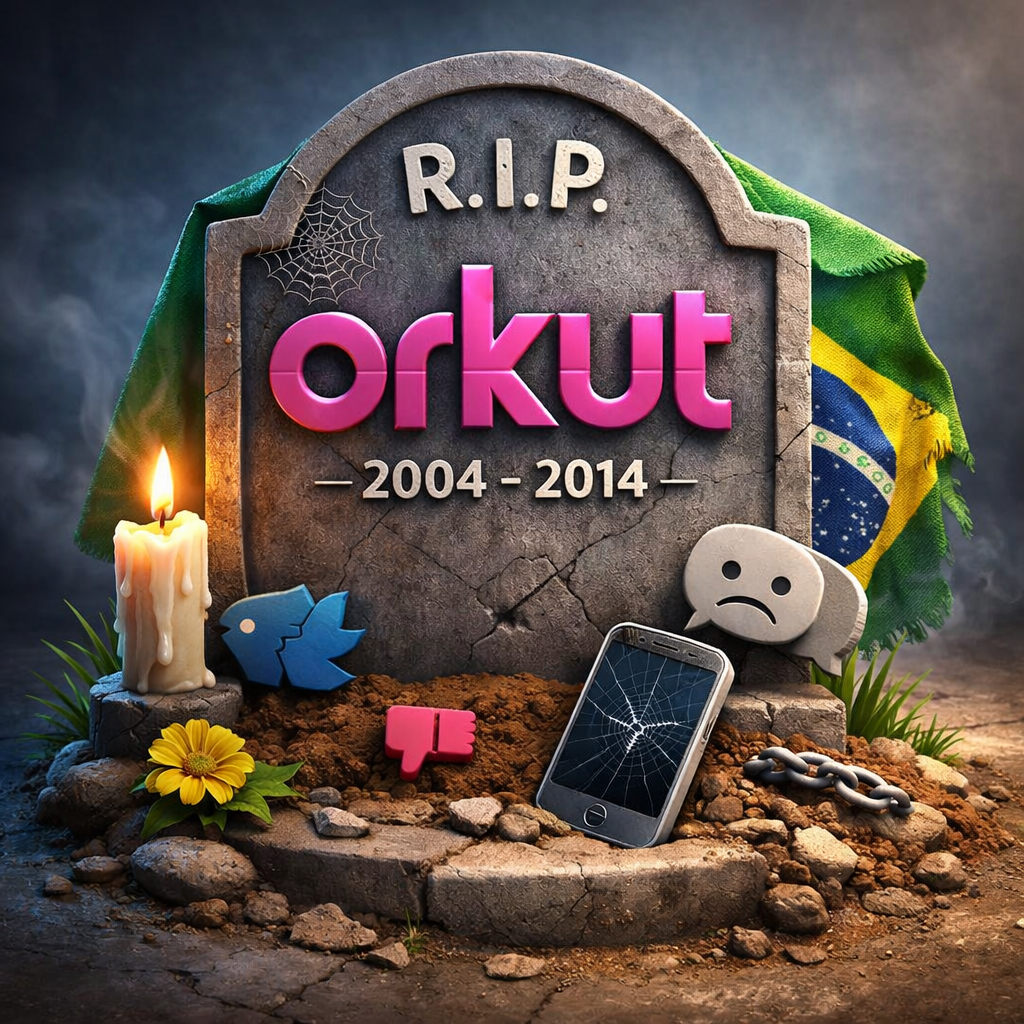
Why Orkut Won Brazil—Then Lost Everything: A Social Media Lesson Most Brands Ignore

What if I told you one of the most successful social networks ever… failed anyway?

Before Facebook dominated globally, before Instagram became culture, there was Orkut—a platform that didn’t just grow… it took over an entire country.

At its peak, 90% of Orkut’s traffic came from Brazil. Let that sink in.

So what went right—and more importantly, what went wrong?

Let’s break it down 👏

🚀 The Rise: Why Orkut Worked So Well

Orkut wasn’t just another social network. It tapped into human behavior, culture, and exclusivity all at once.

🔑 1. It Made Community the Core Experience

Instead of just “adding friends,” Orkut allowed users to:

  • Join communities based on interests
  • Discover people through shared groups
  • Connect through schools, jobs, and locations

👉 This created identity-based engagement, not just social interaction.

🔒 2. Exclusivity Created Demand

Early on, Orkut was invite-only.

That simple move did two powerful things:

  • Built perceived value
  • Made users feel like insiders

This is classic social psychology—people want what they can’t easily access.

🌎 3. It Matched Brazilian Culture Perfectly

This is where Orkut really dominated.

Brazil had:

  • A strong social-first culture
  • High trust in peer recommendations
  • Rapid growth in digital and mobile usage

And Orkut delivered exactly what users wanted:

  • Community interaction
  • Social validation (ratings like “cool” and “trustworthy”)
  • Easy connection with others

👉 It wasn’t just a platform—it became part of daily life.

⚠️ The Fall: Where Orkut Lost Everything

Here’s the part most people miss… Orkut didn’t fail because it started weak. It failed because it stopped evolving.

❌ 1. Poor User Experience Over Time

  • Slow loading times
  • Limited features
  • Restrictions on connections

In a world where user expectations constantly rise… friction kills growth.

❌ 2. Lack of Content Evolution

  • Video
  • Mobile-first experiences
  • Rich media sharing

Orkut stayed relatively basic—a huge problem in a market that loves visual and interactive content.

❌ 3. It Ignored Cultural Shifts

  • Social video
  • Mobile engagement
  • Seamless sharing

Orkut didn’t keep up—and when platforms stop matching culture, users leave. Fast.

🤔 The Marketing Lesson (This Is What Most People Miss)

Orkut proves something powerful: social media success is not about being first—it’s about staying relevant. Here’s what that means in practice:

📍 What Orkut Got Right

  • Built community-first engagement
  • Leveraged exclusivity psychology
  • Aligned with local culture

📍 What Orkut Got Wrong

  • Failed to adapt to user behavior
  • Ignored content evolution (video, mobile)
  • Didn’t innovate fast enough

🔗 Real-World Connection: Why This Still Matters Today

  • Facebook struggling with younger audiences
  • Snapchat losing ground to TikTok
  • Even X (Twitter) constantly reinventing itself

Platforms don’t die because they’re bad—they die because they stop adapting.

📊 The Deeper Insight (MBA-Level Thinking)

From a strategy perspective, Orkut highlights a key concept: Technology + Culture = User Behavior.

  • Platforms succeed when they match how people live and interact
  • Not just what technology can do
  • When that alignment breaks… growth stops

💡 If I Were Rebuilding Orkut Today…

  • Introduce short-form video content
  • Build mobile-first design
  • Use AI-driven recommendations
  • Create creator-based communities
  • Add social commerce features

In other words… turn Orkut into a modern ecosystem, not just a network.

🎯 Final Takeaway

Orkut didn’t fail because it lacked users—it failed because it lost relevance. And in social media marketing, that’s everything. Attention is earned. Relevance is maintained.

🔗 Expand Your Insight (External Links)

How WeChat Turned Everyday Actions Into Habit (And What Marketers Can Learn)

Weixin (WeChat) shows how an all-in-one app turns convenience into habit—through timing, low friction, and culturally smart campaigns.

Photo by http://www.kaboompics.com on Pexels.com

Why Did WeChat Grow So Fast?

Most apps fight for attention.

WeChat removed the need to leave.

That’s the difference—and it’s why it didn’t just “go viral,” it became a daily habit for hundreds of millions of users.

It Was Never “Just Another Chat App”

In social media marketing, we often talk about search costs—the hidden effort users spend jumping between apps to get things done. WeChat eliminated that problem. Instead of forcing users to switch between messaging apps, payment platforms, browsers, and social feeds, it combined everything into one seamless experience.

Think about your own habits for a second: How often do you leave one app just to complete a simple task? WeChat asked a better question: What if users never had to leave at all? That shift—from multiple platforms to one ecosystem—is what made WeChat powerful.

The Red Envelope Campaign: Culture + Gamification + Virality

  • Suspense: randomized distribution created excitement.
  • Participation: group gifting fosters conversation.
  • Repeat use: holiday frequency drives habit.
  • Enter the Red Envelope campaign. It blended culture (holiday gifting), emotion (surprise), and social proof (everyone’s doing it). It didn’t feel like fintech. It like fun, tradition, and generosity—updated for smartphones.

As a16z put it, red envelopes were a “secret weapon” for driving mobile payment adoption. That’s a masterclass in digital influence: use the medium (social messaging) to normalize the action (digital payments).

Habit Engineering: How WeChat Builds Daily Use

Here’s how WeChat engineered a loop where every action leads you deeper into the ecosystem:

  • You message a friend → you stay in the app
  • You read an article → you stay in the app
  • You pay a bill → you stay in the app

The more you do, the less you leave. It’s a closed-loop experience—and it’s the same principle behind today’s “super apps.”

What Modern Marketers Should Take From This

  • Audience: young, mobile-first users
  • Needs: convenience and efficiency (reduce search costs)
  • Behavior: reduce effort and time; remove friction

If a platform becomes part of someone’s routine, it stops competing for attention—it becomes a habit. That’s the real lesson: remove friction until participation feels effortless.

For more on how social behaviors can sometimes feel impactful but fall short in reality, check out my post: The Slacktivism Trap: When Viral Awareness Feels Good—but Achieves Nothing.

Learn More and Sources

 For readers who want to dive deeper into the psychology and strategy behind platforms like WeChat, the HBS Digital Initiative offers an in-depth article on how the messaging app became a super-app. Additional recommended readings include the Fogg Behavior Model (B=MAP), which explains how motivation, ability, and prompts interact to drive behavior; Albert Bandura’s work on self-efficacy; and Nielsen Norman Group research on reducing cognitive load for smoother user experiences. These resources will help you design social media campaigns that not only capture attention but also build lasting habits.

For a comprehensive look at planning and executing social media programs, explore the textbook Strategic Social Media Management: Theory and Practice

If you have thoughts or questions, feel free to leave a comment below!

Leave a comment

AI Music and the Future of Hip-Hop: Why the Next Great Artist Might Be You

By Debynyhan Banks — March 8, 2026

Born the Same Year Hip-Hop Went Global

I was born in 1978.

That same year, “Rapper’s Delight” by The Sugarhill Gang hit the airwaves and helped bring hip-hop to the world. In a way, my life has grown alongside the culture itself. I’ve watched hip-hop evolve from cassette tapes and boom boxes to streaming platforms and global stadium tours.

Hip-hop and R&B were always the soundtrack of my life.

But here’s something people might not expect: I never thought I had musical talent.

I loved the beats. I loved the rhythm. I loved the flow. But being an artist felt like something reserved for people with studio access, natural musical ability, or industry connections.

So instead of creating music… I listened.

When the Message Started to Change

As I grew older—and hopefully wiser—my taste in music began to shift.

I started listening more to reggae, not just for the rhythm but for the message. Reggae often carries themes of consciousness, struggle, reflection, and spirituality.

And it made me start asking questions.

Because over time, something else was happening in mainstream music.

Lyrics that once would have shocked people were suddenly playing on daytime radio. Explicit and degrading themes became normalized. The message started to feel repetitive.

At some point I had to ask myself:

When did this become the dominant message of our culture?

And maybe an even deeper question:

Who decided these were the only voices we should hear?

The Gatekeepers of the Music Industry

For decades the music industry operated through gatekeepers.

Record labels, radio stations, and executives largely determined which artists reached the public. That meant audiences often heard the same themes, the same narratives, and the same perspectives repeated over and over again.

But was that really the full diversity of thought within the culture?

Or just the voices that had access to the microphone?

Many people like me—people who loved hip-hop but didn’t necessarily fit the mold—eventually stepped away from the scene. Not because we stopped loving the art form, but because the messages no longer reflected our values.

But the beat?

The flow?

The art of storytelling through rhythm?

That love never left.

Hip-Hop Was Built on Technology

Here’s the interesting part.

Hip-hop itself was built on innovation.

Turntables turned records into instruments.
Samplers allowed producers to reshape sound into something entirely new.
Drum machines helped define the sound of entire generations.

And every time a new technology appeared, critics said the same thing:

Sampling wasn’t real music.
Auto-Tune wasn’t real music.
Digital production wasn’t real music.

And yet today, those tools are part of the foundation of modern music.

So the real question is:

Is artificial intelligence really different?

Or is it simply the next tool in the evolution of creativity?

AI Is a Tool—Nothing More, Nothing Less

Artificial intelligence is opening a new door in the creative world.

Tools like ChatGPT and platforms like Suno AI allow people to experiment with songwriting, structure, and musical ideas in ways that previously required professional studios and industry connections.

For the first time, someone who never considered themselves an artist can explore creative expression through music.

Some critics say AI-assisted music isn’t authentic.

But let’s ask a real question:

Has music ever truly been created alone?

The industry has relied on collaboration for decades. Ghostwriters, producers, beat makers, engineers, and songwriting teams have helped create countless hit records behind the scenes.

AI doesn’t replace creativity.

It expands access to creativity.

A hammer doesn’t build a house by itself.
A camera doesn’t make a movie on its own.

And AI doesn’t create meaningful music without a human vision behind it.

A Different Kind of Message

Now imagine something different.

For years the industry mostly amplified a narrow set of voices and perspectives. But what happens when the barriers to entry disappear?

What happens when the people making music come from completely different backgrounds?

With AI-assisted tools, someone with a PhD in philosophy, a scientist, a teacher, a software engineer, or a business leader can now experiment with music and express ideas through rhythm and flow.

Think about that for a moment.

Imagine a philosopher dropping bars about consciousness and meaning.

Imagine a scientist rapping about discovery and innovation.

Imagine a 50-year-old engineer who grew up loving hip-hop but stepped away because the dominant messages didn’t align with his values… finally stepping back into the culture with a different perspective.

What happens when those voices enter the conversation?

The flow is still hip-hop.

The beat is still hip-hop.

But the message expands.

And maybe that’s what this moment is really about.

Not replacing artists.
Not replacing creativity.

But expanding the range of ideas that hip-hop can carry.

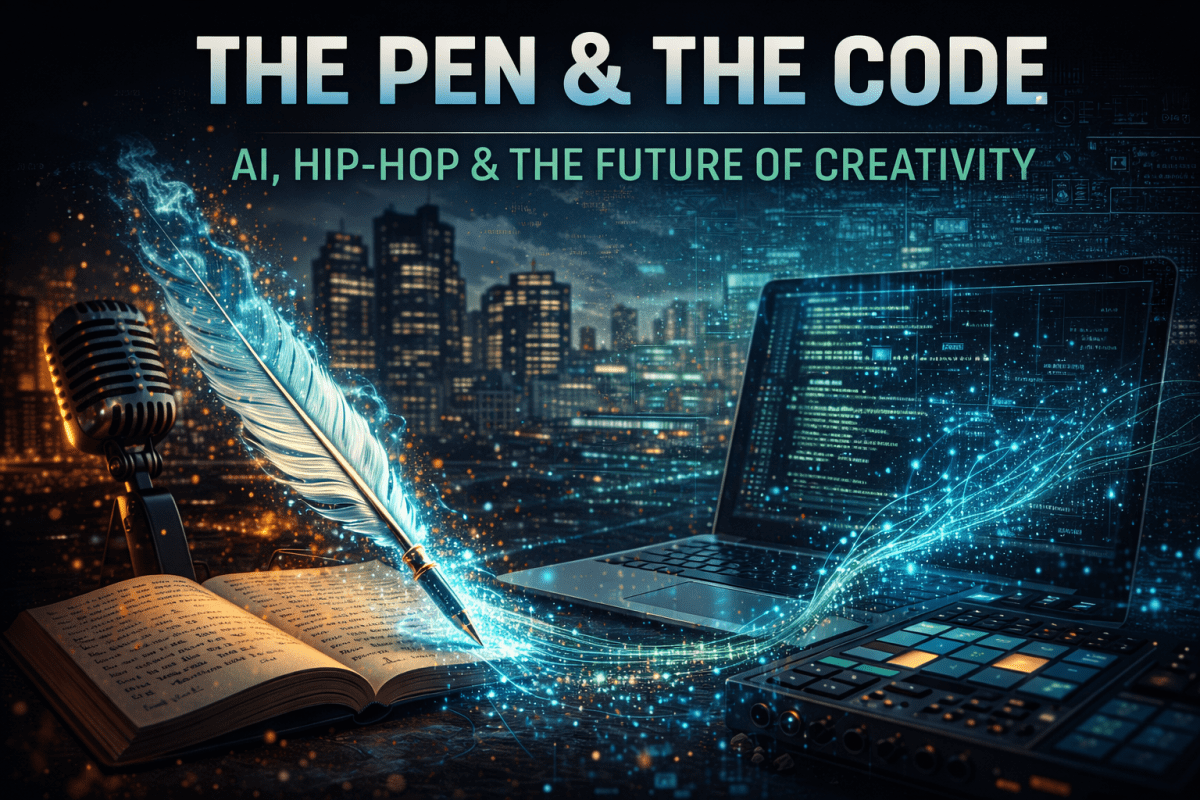
The Pen & The Code

That idea inspired my new single:

The Pen & The Code.

The pen represents human creativity, storytelling, and thought.

The code represents the digital tools that help bring those ideas to life.

Together they represent something bigger than a single song—the intersection of culture, creativity, and technology.

The track is now available on Spotify, Apple Music, iTunes, and all major streaming platforms, distributed through DistroKid.

For me, the song represents a simple idea:

Technology doesn’t replace creativity.

It gives creativity new voices.

The Real Question


Artificial intelligence isn’t the end of music.

It might actually be the beginning of something more diverse and more thoughtful.

Because when the barriers to entry disappear, new voices appear.

Voices that were never part of the industry conversation before.

Voices from different professions.

Different life experiences.

Different perspectives.

So I’ll leave you with one final thought:

Hip-hop was never meant to belong to a small group of gatekeepers.

It was always meant to be a voice for the people.

And now, for the first time in history, the tools of creation are finally in the hands of everyone.

Which means the future of music might not come from a label.

It might come from a laptop.

And the next great artist?

They might not be famous yet.

They might be a teacher…

a scientist…

a builder…

a thinker…

or someone who simply had something meaningful to say and finally found the tools to say it.

Because when the pen meets the code, the next voice in hip-hop could be anyone.

Stream the album:

Available on YouTube

Watch the video on YouTube

Stream the single