By Debynyhan Banks — March 8, 2026
Born the Same Year Hip-Hop Went Global
I was born in 1978.
That same year, “Rapper’s Delight” by The Sugarhill Gang hit the airwaves and helped bring hip-hop to the world. In a way, my life has grown alongside the culture itself. I’ve watched hip-hop evolve from cassette tapes and boom boxes to streaming platforms and global stadium tours.
Hip-hop and R&B were always the soundtrack of my life.
But here’s something people might not expect: I never thought I had musical talent.
I loved the beats. I loved the rhythm. I loved the flow. But being an artist felt like something reserved for people with studio access, natural musical ability, or industry connections.
So instead of creating music… I listened.
When the Message Started to Change
As I grew older—and hopefully wiser—my taste in music began to shift.
I started listening more to reggae, not just for the rhythm but for the message. Reggae often carries themes of consciousness, struggle, reflection, and spirituality.
And it made me start asking questions.
Because over time, something else was happening in mainstream music.
Lyrics that once would have shocked people were suddenly playing on daytime radio. Explicit and degrading themes became normalized. The message started to feel repetitive.
At some point I had to ask myself:
When did this become the dominant message of our culture?
And maybe an even deeper question:
Who decided these were the only voices we should hear?
The Gatekeepers of the Music Industry
For decades the music industry operated through gatekeepers.
Record labels, radio stations, and executives largely determined which artists reached the public. That meant audiences often heard the same themes, the same narratives, and the same perspectives repeated over and over again.
But was that really the full diversity of thought within the culture?
Or just the voices that had access to the microphone?
Many people like me—people who loved hip-hop but didn’t necessarily fit the mold—eventually stepped away from the scene. Not because we stopped loving the art form, but because the messages no longer reflected our values.
But the beat?
The flow?
The art of storytelling through rhythm?
That love never left.
Hip-Hop Was Built on Technology
Here’s the interesting part.
Hip-hop itself was built on innovation.
Turntables turned records into instruments.
Samplers allowed producers to reshape sound into something entirely new.
Drum machines helped define the sound of entire generations.
And every time a new technology appeared, critics said the same thing:
“That’s not real music.”
Sampling wasn’t real music.
Auto-Tune wasn’t real music.
Digital production wasn’t real music.
And yet today, those tools are part of the foundation of modern music.
So the real question is:
Is artificial intelligence really different?
Or is it simply the next tool in the evolution of creativity?
AI Is a Tool—Nothing More, Nothing Less
Artificial intelligence is opening a new door in the creative world.
Tools like ChatGPT and platforms like Suno AI allow people to experiment with songwriting, structure, and musical ideas in ways that previously required professional studios and industry connections.
For the first time, someone who never considered themselves an artist can explore creative expression through music.
Some critics say AI-assisted music isn’t authentic.
But let’s ask a real question:
Has music ever truly been created alone?
The industry has relied on collaboration for decades. Ghostwriters, producers, beat makers, engineers, and songwriting teams have helped create countless hit records behind the scenes.
AI doesn’t replace creativity.
It expands access to creativity.
A hammer doesn’t build a house by itself.
A camera doesn’t make a movie on its own.
And AI doesn’t create meaningful music without a human vision behind it.
A Different Kind of Message
Now imagine something different.
For years the industry mostly amplified a narrow set of voices and perspectives. But what happens when the barriers to entry disappear?
What happens when the people making music come from completely different backgrounds?
With AI-assisted tools, someone with a PhD in philosophy, a scientist, a teacher, a software engineer, or a business leader can now experiment with music and express ideas through rhythm and flow.
Think about that for a moment.
Imagine a philosopher dropping bars about consciousness and meaning.
Imagine a scientist rapping about discovery and innovation.
Imagine a 50-year-old engineer who grew up loving hip-hop but stepped away because the dominant messages didn’t align with his values… finally stepping back into the culture with a different perspective.
What happens when those voices enter the conversation?
The flow is still hip-hop.
The beat is still hip-hop.
But the message expands.
And maybe that’s what this moment is really about.
Not replacing artists.
Not replacing creativity.
But expanding the range of ideas that hip-hop can carry.
The Pen & The Code
That idea inspired my new single:
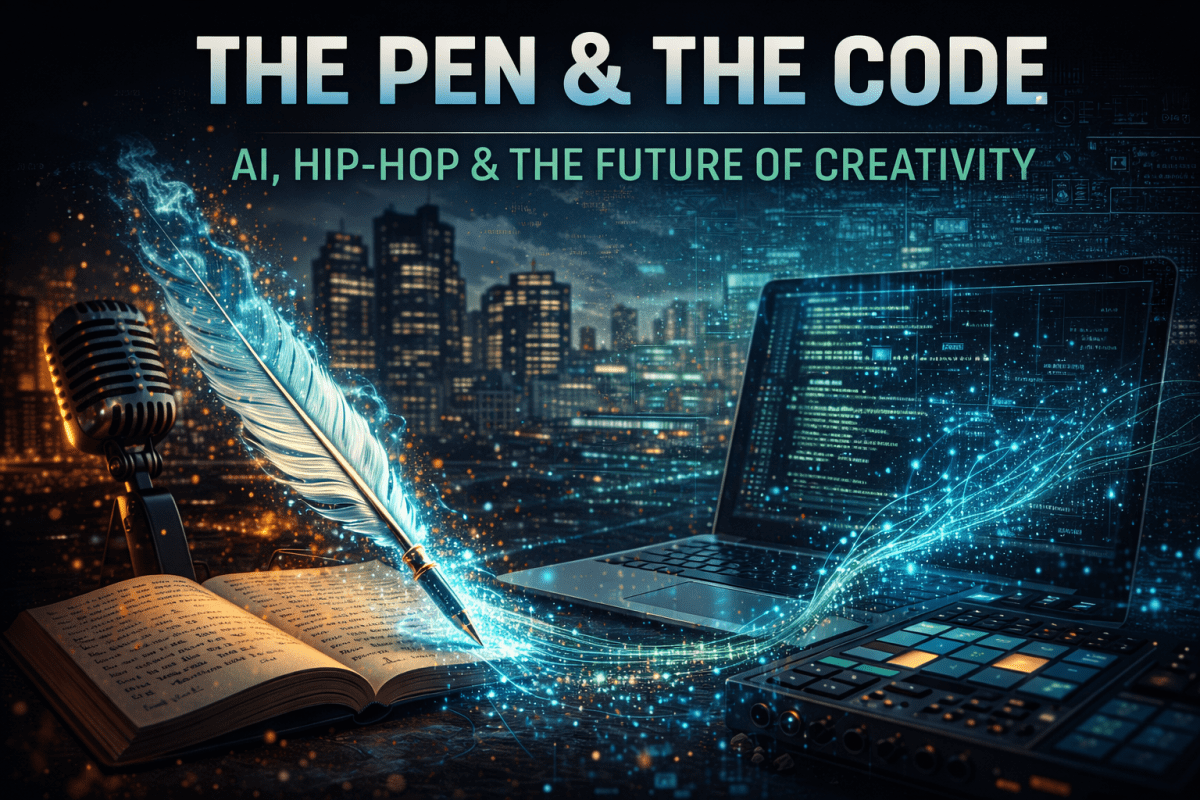
The pen represents human creativity, storytelling, and thought.
The code represents the digital tools that help bring those ideas to life.
Together they represent something bigger than a single song—the intersection of culture, creativity, and technology.
The track is now available on Spotify, Apple Music, iTunes, and all major streaming platforms, distributed through DistroKid.
For me, the song represents a simple idea:
Technology doesn’t replace creativity.
It gives creativity new voices.
The Real Question
Artificial intelligence isn’t the end of music.
It might actually be the beginning of something more diverse and more thoughtful.
Because when the barriers to entry disappear, new voices appear.
Voices that were never part of the industry conversation before.
Voices from different professions.
Different life experiences.
Different perspectives.
So I’ll leave you with one final thought:
Hip-hop was never meant to belong to a small group of gatekeepers.
It was always meant to be a voice for the people.
And now, for the first time in history, the tools of creation are finally in the hands of everyone.
Which means the future of music might not come from a label.
It might come from a laptop.
And the next great artist?
They might not be famous yet.
They might be a teacher…
a scientist…
a builder…
a thinker…
or someone who simply had something meaningful to say and finally found the tools to say it.
Because when the pen meets the code, the next voice in hip-hop could be anyone.
Stream the album:
 Digital Influence Strategy